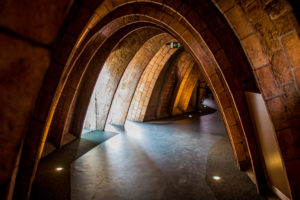
Monastery of Pedralbes, Barcelona
The Monastery of Pedralbes in Barcelona, now a museum, housing permanent exhibitions consisting of art collected by the monastery, and visiting exhibitions.
Rotate to landscape to view slideshow
Park Guell, Barcelona, was originally conceived as a real estate sub-division for the wealthy. A few houses were built for those closely involved with the project, but a lack of buyers led to the works being abandoned in 1914.
The land was eventually offered to the City Council who turned the area into a park for the people.
Architect Antoni Gaudi was involved in the design of the sub-division and also lived in one of the houses built on the site. The land sits on the side of a hill and offers good views over the city and out to the sea. It is very popular with locals as a recreation area. Indeed, in certain areas of the park, the number of people allowed in at any one time is restricted – your entry ticket stipulates a time when you can enter the park.
The day we visited was sunny and warm. People strolled around the paths that cross over the hillside, enjoying a picnic or listening to buskers.
There is plenty of evidence of architect Gaudi’s work, including his use of broken ceramic tiles to make mosaics, including a marvelous lizard.
The Monastery of Pedralbes in Barcelona, now a museum, housing permanent exhibitions consisting of art collected by the monastery, and visiting exhibitions.
A great day along car-free streets with plenty of interesting things to see – Poble Espanyol
In Plaça de la Vila de Gràcia, Barcelona there’s a clock tower. And occassionally other towers spring up in the square – but these are people towers.
Hobart’s renowned open air market was established in 1972 so it’s coming up for its 50th Anniversary.
Down the Western Explorer highway, through Corinna, Zeehan and Strahan for a day on Macquarie Harbour.
Bayeux is a picturesque medieval village in Western France, largely unscared by past conflicts, but with a unique connection to the past.